
Automotive fluid systems often need tubing that fits around tight engine compartments, connects components with different geometries, or accommodates movement without restricting flow. Standard round tubing cannot solve every packaging challenge, particularly when a design calls for an oval bore, a corrugated section joined to a smooth tube, or an integrated profiled connector.
Developing custom extruded plastic components involves translating these functional requirements into a manufacturable cross-section, then validating the tooling, material behavior, and dimensional performance through controlled trials.
Translating the Engineering Brief Into a Tube Profile
A successful profile begins with a clear description of the operating environment. Engineers need to understand the fluid being transported, working temperature, pressure range, vibration exposure, available installation space, and expected service life. Coolant lines, air ducts, fuel-related components, and washer-fluid tubes can face very different chemical and thermal conditions, so a profile that works in one application may be unsuitable for another. Connection requirements and assembly tolerances also need to be documented before tooling development starts.
Cross-sectional geometry should reflect the actual functional need. An oval bore may help a tube fit within a restricted space while preserving a specified flow area, but its width-to-height ratio can affect pressure drop and resistance to deformation. Corrugated sections offer flexibility where movement or vibration must be accommodated, whereas smooth sections may be better suited to sealing, routing, or connection interfaces. Engineers must consider how these features interact rather than evaluate each shape independently.
The engineering brief should ultimately become a measurable specification. Drawings need to identify critical dimensions, tolerances, wall-thickness requirements, bend radii, connector interfaces, and permitted variation. Where performance depends on movement or pressure, the specification should also define relevant test conditions. Clear acceptance criteria help the design team distinguish essential functional features from cosmetic preferences, keeping subsequent tooling decisions focused on measurable requirements.
Matching Materials and Tooling to Complex Geometries
Material selection affects both the final component and the extrusion process. Automotive tubing may use polyamide, polypropylene, thermoplastic elastomers, or other polymers, depending on fluid compatibility, temperature exposure, flexibility, and mechanical demands. Each material behaves differently during melting, flow, cooling, and shrinkage. Engineers must consider these characteristics alongside regulatory requirements and the supplier’s material data, rather than assuming that a resin suitable for a standard tube will behave identically in a complex profile.
Tooling design becomes more demanding when a tube contains asymmetric walls, internal channels, or transitions between flexible and rigid sections. The die must distribute melt around the intended cross-section while accounting for differences in flow resistance. Uneven flow can produce inconsistent wall thickness or distort the profile as it exits the die. Mandrel support, flow-channel geometry, die-lip adjustment, and cooling arrangements all influence whether the extrudate retains the intended shape.
A capable extrusion pipe machine setup must also match the profile’s material and dimensional requirements. Extruder output, screw design, temperature control, die configuration, calibration, and haul-off speed need to operate as a coordinated system. Thin-walled or asymmetrical profiles may require particularly careful calibration because small process fluctuations can cause relatively large dimensional changes. Tooling simulations and engineering calculations can narrow the initial design options, but physical trials remain necessary to confirm actual behavior.
Validating First-Off Samples and Refining Production
The first-off sample provides the first practical evidence that the proposed design can be manufactured. Dimensional inspection should compare the sample with the approved drawing, paying close attention to wall thickness, internal geometry, connector fit, and the transition between corrugated and smooth sections. Visual checks alone are insufficient: a tube may look acceptable while containing local thinning or dimensional deviations that affect assembly and durability.
Functional testing should reflect the intended automotive application. Depending on the component, this may include pressure or leak testing, flow measurement, bend and compression tests, thermal cycling, chemical exposure, vibration resistance, and repeated movement. The test plan should be agreed upon with the customer and based on applicable specifications. Results help determine whether a problem originates in the geometry, material choice, tooling, or process settings, making corrective action more targeted.
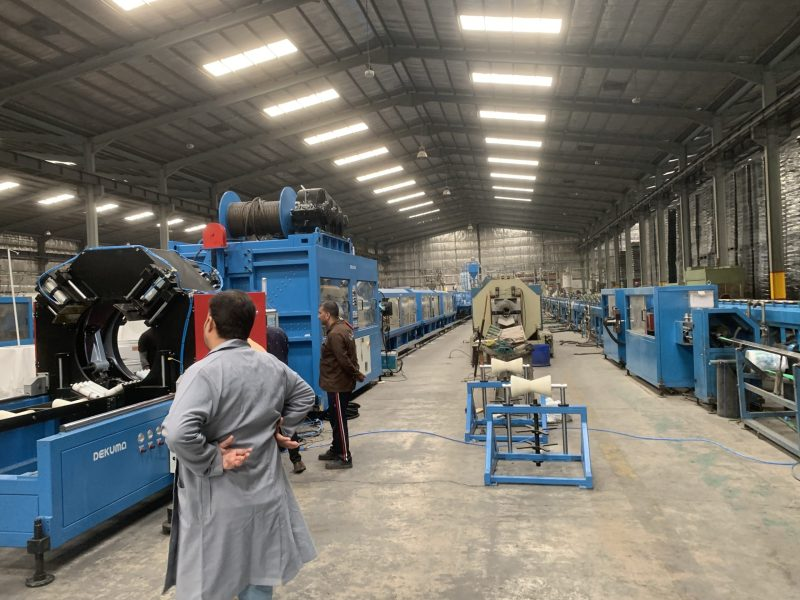
Sample approval should also consider whether the result can be reproduced at production scale. A profile that meets specification during a short trial may behave differently over a longer run as tooling temperatures stabilize or material batches change. Process windows, inspection points, and setup parameters should be recorded before production release. DEKUMA has experience supplying extrusion equipment for specialized pipe applications; its reported eleven-year cooperation with a pipe manufacturer in the Middle East illustrates the value of long-term supplier relationships in industrial production. Project-specific capabilities, however, should be confirmed against the actual automotive profile, polymer, and required testing.
Conclusion
Developing non-standard automotive tubing is an iterative engineering process, not simply a matter of creating an unusual die shape. Functional requirements define the geometry, material properties guide tooling decisions, and first-off testing reveals whether the design performs as intended under realistic conditions. Manufacturers assessing custom extruded plastic solutions should examine design support, trial capabilities, dimensional inspection, and the ability to maintain consistent output after approval.
A suitable extrusion pipe machine must accommodate the profile’s specific processing demands, while communication between component designers, material specialists, and equipment engineers helps resolve problems before production volumes increase. DEKUMA can be assessed as one potential equipment supplier, with final suitability determined by verified technical capability and the requirements of the individual automotive application.