
A lecture hall may host several hours of classes each day, with students moving between lessons, taking notes, and remaining seated for extended periods. Furniture materials influence far more than appearance: they affect body support, surface temperature, cleaning requirements, noise, and how well seats withstand frequent use.
Selecting suitable lecture room seating calls for an understanding of how plastics, upholstery, wood-based panels, and metal components perform together, rather than judging each material in isolation.
How Seat Materials Influence Everyday Comfort
The seat and backrest have the most direct contact with students, so their materials deserve particular attention. Molded polypropylene (PP) is widely used in educational furniture because it can be shaped to support different body contours and is relatively easy to clean. Its firm surface may suit shorter lessons, although extended sessions can benefit from additional cushioning.
Padding changes the way a seat distributes pressure. A layer of foam beneath the upholstery can soften contact points around the thighs and hips, making longer periods of sitting more comfortable. The result depends on foam density, thickness, and resilience; padding that compresses too easily may lose its supportive feel with repeated use.
Backrest design also contributes to comfort. A slightly contoured shell can support the back more naturally than a completely flat surface, while the height and angle determine how much upper-body support is available. In lecture room seating, these details matter because students vary in height and posture, and a single seat design must accommodate a broad range of users.
Comparing Plastics, Upholstery, and Structural Materials
Polypropylene offers a practical balance of shape flexibility and straightforward maintenance. It resists everyday moisture and can be wiped down without the specialist care required by some fabrics. However, its performance depends on material quality, shell thickness, and the way the seat is supported by the underlying frame.
Upholstery introduces a softer contact surface and a wider range of textures. Fabric can provide a warmer feel, while synthetic leather is often selected for surfaces that can be wiped clean. Both options require attention to abrasion resistance, seam construction, and cleaning compatibility, particularly in shared lecture spaces where spills and frequent contact are unavoidable.
Metal components carry the structural load and influence the stability of the furniture. Steel is commonly used for bases, supports, and connecting structures because it offers substantial rigidity. Aluminum can be useful in moving mechanisms where lower weight and controlled movement are important. The finish matters too: powder coating creates a protective surface, while poorly finished joints or exposed edges may become maintenance concerns.
Why Tabletop and Frame Construction Matter
Writing surfaces are essential in lecture halls where students use notebooks, laptops, or other learning materials. Particle board and plywood are common panel options, often finished with a laminate layer that provides a usable surface and simplifies routine cleaning. Their suitability depends on panel thickness, edge protection, fastening methods, and resistance to moisture.
The connection between the tabletop and its support structure deserves close inspection. A broad surface may provide ample working room, but insufficient support can lead to movement or flexing during everyday use. Stable brackets, properly secured fasteners, and suitable frame dimensions help maintain a consistent writing area without interfering with legroom.
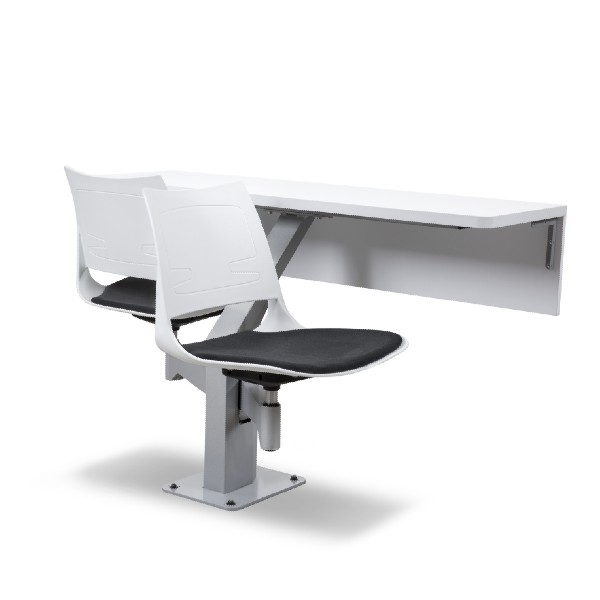
The Titan LS-420 illustrates how several materials can work within one educational seating system. It features a PP back, a padded PP seat, and a 25 mm laminated particle-board tabletop, supported by a powder-coated cold-rolled steel structure. Its swivel seats rotate 360 degrees and move forward and backward on pivoting aluminum arms, allowing students to collaborate across rows.
Matching Material Choices With Lecture Hall Conditions
Material selection should reflect the room’s layout and daily schedule. A high-capacity lecture theatre may prioritize surfaces that are easy to clean and structures that remain stable under frequent use. Smaller teaching rooms, on the other hand, may place greater emphasis on tactile comfort and furniture that supports discussion or collaborative learning.
Environmental conditions can also affect material performance. Rooms exposed to strong sunlight may experience greater heat buildup on certain surfaces, while humid environments require attention to panel edges, joints, and protective finishes. Cleaning products should be compatible with the chosen materials; harsh chemicals can damage coatings, discolor upholstery, or weaken some surface finishes over time.
Maintenance planning is another part of the selection process. Facilities teams should be able to inspect fasteners, identify worn padding, clean contact surfaces, and replace damaged components without unnecessary disruption. A well-documented material specification makes it easier to establish suitable cleaning routines and identify which parts may require periodic attention.
Conclusion
Comfort and durability rarely come from a single material. They emerge from the relationship between the seat shell, cushioning, frame, writing surface, and the construction methods that hold these elements together. Institutions evaluating lecture room seating can compare these factors against actual teaching conditions rather than relying on appearance alone.
Leadcom Seating offers educational furniture configurations that combine different materials and functional features, providing options for varied classroom layouts. Ultimately, the most suitable specification is one that supports students throughout a lesson while remaining practical for the people responsible for maintaining the space.