
Textile mills depend on many motor-driven processes, but these motors do not all work under the same conditions. Spinning machines, winders, pumps, fans, and dyeing equipment may each require a different industrial ac drive configuration because their torque, speed, and restart demands vary. For this reason, drive selection should begin with the machine load and duty cycle rather than with inverter size or hardware density alone.
Different Textile Machines Create Different Loads
A textile plant may use constant-torque and variable-torque equipment within the same production area. Ventilation fans often work differently from winding or processing machines. Engineers therefore need to check rated current, overload demand, acceleration time, speed range, and operating hours for each application.
Load changes are especially important on equipment where material tension or processing resistance varies during operation. If the motor experiences sudden resistance, the drive must respond without causing unstable speed or unnecessary current fluctuation.
A smart electric drive can help manage changing speed commands and motor conditions, but its control capability must still match the machine. Using the same drive specification for every textile motor may result in unnecessary cost or poor operating margins.
Why Power Density Is Only One Factor
Higher power density allows more output capacity to fit into a smaller inverter body. This can be useful where electrical cabinets have limited space or where several drives need to be installed together.
However, compact construction also makes thermal planning important. Textile plants may contain lint, fibers, dust, and elevated ambient temperatures. These conditions can affect airflow around electrical equipment. Cabinet ventilation, installation spacing, cleaning access, and inverter derating should therefore be reviewed before reducing enclosure size.
A small inverter does not automatically improve machine performance. Engineers should first confirm that current capacity, overload behavior, temperature limits, and cooling conditions are suitable for the intended duty.
Motor Restart Conditions Need Attention
Many textile machines contain rotating parts with noticeable inertia. After a brief power interruption or stop command, the motor may continue rotating instead of stopping immediately.
Restarting such a motor without considering residual speed can produce current impact or mechanical stress. This issue matters on fans, rollers, winding equipment, and other machines that may coast for several seconds.
Speed tracking can be useful in these situations. The drive identifies the motor’s existing direction and rotational speed before applying output. This allows the restart process to follow the actual motor condition rather than forcing an immediate start from zero speed.
Control Stability Matters During Heavy Loads
Textile processes often depend on stable motor behavior. Changes in motor speed can affect yarn tension, airflow, winding consistency, or processing rhythm. The inverter therefore needs to respond properly when the load increases.
Current compensation is one function that can support this operating condition. When load becomes heavier, suitable compensation can help the drive maintain a more stable output voltage. V/F control behavior also matters when the motor and process require specific voltage-frequency relationships.
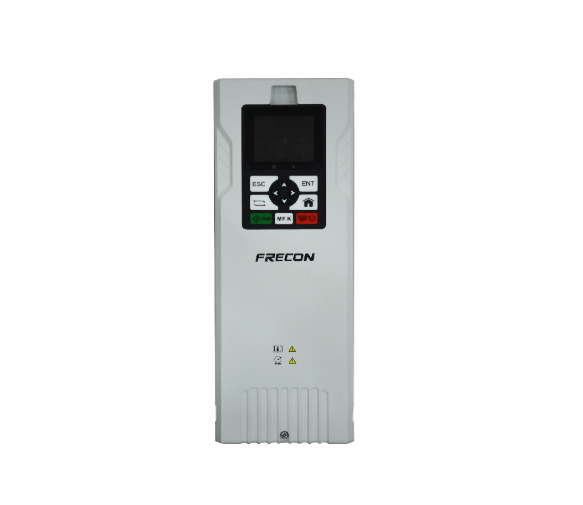
This is where product functions become relevant to the wider selection process. FRECON provides the FR30 Series High Performance Inverter, which can operate when V/F control is fully separated or semi-detached. According to the supplied product information, it can automatically compensate current under heavy loads to maintain constant output voltage.
Where Speed Tracking Can Support Production
The FR30 also includes a speed tracking function. When rapid startup is required, the drive can follow the motor’s current running direction and rotational speed to achieve a smoother start with less impact.
This feature may be useful for equipment that has not completely stopped before a restart. However, machine builders should still evaluate mechanical inertia, braking methods, motor characteristics, and safety requirements before deciding how the restart sequence should operate.
Rather than treating one feature as a universal solution, engineers can use these functions as part of a broader comparison. FRECON can be assessed together with other drive options by checking whether its control functions suit the actual machine load and operating sequence.
When Compact Hardware Makes Practical Sense
An industrial ac drive using compact hardware can be useful when cabinet space is limited, several motor drives share one enclosure, or machine builders want to reduce control-panel dimensions.
The value of a high power density inverter is therefore closely related to installation conditions. Space savings may be useful, but they should not replace checks on thermal performance, overload capability, maintenance access, and surrounding environmental conditions.
A smart electric drive should also be judged by how well it handles speed changes, heavy loads, restart behavior, and continuous operation. These factors usually have a more direct effect on textile machinery than inverter size alone.
Selecting Around the Machine, Not the Label
Textile mills do not automatically require high-density inverter hardware for every motor. Some applications benefit from compact installation, while others place more emphasis on overload capability, cooling margins, or restart performance.
The practical approach is to review motor current, torque characteristics, duty cycle, residual-speed conditions, cabinet space, and temperature before selecting the drive. This keeps the decision connected to the real production process.
For textile projects, power density should therefore be treated as one selection factor rather than the main requirement. A suitable drive combines electrical capacity, control response, thermal conditions, and machine behavior in a way that matches the actual operating environment.